All Yono Store: APK Guide: Files, Versions and Android Installation
For Android readers in India: identify the All Yono Store package, compare its app…


Last updated: 20 October 2026
Rummy 365 identifies the product, while a release label identifies a particular build. Establish both when comparing Android files. Also determine whether you are installing for the first time or changing an existing copy, since that affects which directions and messages apply.
Before following another Rummy 365 destination, decide what you need to learn. Account instructions, game descriptions and release entries address different questions. Reading the relevant material in sequence makes a broad search easier to navigate.
For Android users in India, this guide connects the available product details to the tasks they explain. Use that context to make sense of individual labels.
The subject is the Android installation package. A filename cannot stand in for the full product description; keep the file record tied to the intended app while organising the download enquiry.
Select the subject behind a Rummy 365 result before using its instructions. A review concerns the product, an APK guide the installation package and a login guide an account already created. Game titles and account-feature pages need not answer the same question.
Check the name against the destination’s details. Artwork and familiar wording do not identify the publisher. If records disagree, pause the transfer and compare them rather than choosing a result simply because it appears first.
APK denotes an Android package, not an additional game mode. Determine whether the page describes Rummy 365 overall, a build or its installation procedure. Related descriptions are not necessarily interchangeable.
Identify the product, examine its release details and inspect the destination before letting the file transfer complete. An incomplete download does not become usable because a guide provides instructions. Uncertain file details call for consulting the app record, not guessing from the filename.
Keep separate notes for your Android system version, downloaded package and existing installation. These are three different records. Guidance about one of them may not describe the others.
Distinguish completed downloads from transfers still in progress. Check whether directions concern a fresh install or an update, particularly on a handset that already contains an older Rummy 365 copy alongside other apps.
Find the finished package in Downloads and read the system prompt. Keep a brief account of the file and every installation attempt’s result. Record any displayed message before turning to troubleshooting material.
After installation, inspect the app’s information area rather than relying solely on a shortcut label. Compare its version with your intended build so that installed software, package and instructions remain connected.
A version number identifies the Rummy 365 build. Its accompanying notes explain whether changes concern compatibility, the interface, a feature or a correction. Read the description rather than expecting the number itself to explain the change.
Note the installed build before comparing a different file. Similar names may identify separate products rather than updates. A dated list of releases is not a recommendation to install each package; inspect entries individually.
Identify the point of failure first: an ongoing download, Android installation, app launch or an account screen. That distinction narrows the Rummy 365 enquiry before any changes are made.
Record each check and outcome separately. A network change, completed transfer and alternative release are distinct events; combining them makes their effects uncertain. A help request should include a concise reproducible sequence with the relevant device and build details.
Read the listing as a complete record before following a destination. One entry’s size and another entry’s version do not identify a particular release. Compare corresponding fields for the same application.
The short listing gives initial orientation, while the article provides fuller context. For an unclear term, follow the explanation in its relevant guide instead of inferring its meaning from the summary card alone.
For a question that remains unanswered, provide the fewest steps needed to reproduce the result. Include Rummy 365, the relevant build, Android release and exact message. Explain the expected behaviour as well as the observed outcome.
Keep a broken link, failed transfer and account error in separate notes, even if encountered together. Each is a different enquiry; a focused description reduces the chance of support addressing the wrong one.
Finish the part concerning your current app, handset or game, then turn to related material for another subject. A useful outcome is identifying the next relevant question, without completing every possible task in one visit.
List unanswered details and seek clarification instead of making assumptions. A short question with a clear subject offers a better next step than repeatedly moving between unrelated pages.
Save the checklist beside the file record to resume work later. If a check changes the result, document that difference before the next action. This distinguishes the original symptom from subsequent effects.
Important: APK availability and app information can change. This guide is for informational purposes and does not guarantee that a particular APK is official, safe, current, or suitable for your device.
| Detail | Listing A | Listing B |
|---|---|---|
| App name | Rummy 365 | Rummy 365 |
| Publisher | Check | Check |
| Version | Check | Check |
| Package name | Check | Check |
| File size | Check | Check |
| Android requirement | Check | Check |
| File type | APK/XAPK | APK/XAPK |
| Update date | Check | Check |
| Source | Check | Check |
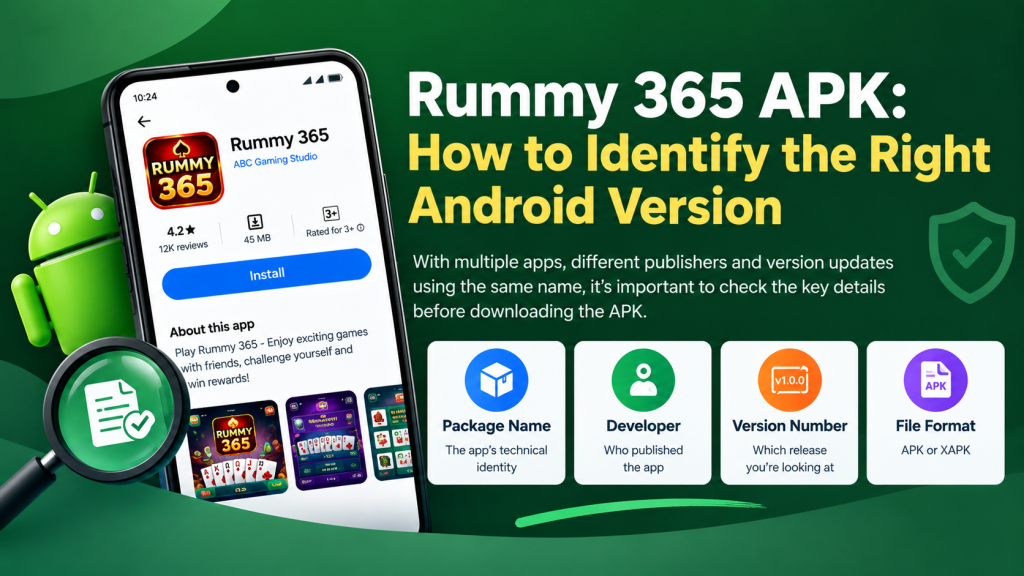
Before retrieving a package from any listing, establish the intended application. Examine the publisher, package particulars, build, source and Android requirements; a matching page title alone is inadequate.
Cross-check the release number, update details, package information and publisher using reliable sources. A “latest” label by itself does not establish the current build.
The names might describe one application, but wording alone cannot prove that relationship. Compare publisher, package identifier and version to establish whether the files belong together.
An Android download may use XAPK or another format rather than a single APK. Inspect the extension before attempting installation.
Check the specific error before replacing the file. Potential causes include insufficient space, Android incompatibility, an existing-installation conflict, corruption or an unsupported format.
An earlier release may install on a compatible handset, but confirm its source, package identity and Android requirements first. It may lack later updates or compatibility improvements.
Find the installed build through Android’s App Info or, if provided, the application’s About or version screen. Compare that value with the source’s listing.
No APK should be considered safe simply because it uses the correct application name. Check the source, package identity, permissions and file details before installation.
 Apk Download Guide
For Android readers in India: identify the All Yono Store package, compare its app…
 Apk Download Guide
Separate a Love Rummy Yono search phrase from the actual app record, with guidance…
 Apk Download Guide
Investigate the Gogo Rummy Android package: identify the build, compare release records and distinguish…