66 Rummy on Android: Games and Getting Started
Use this 66 Rummy overview to connect game formats, Android records and account questions…


Last updated: 20 October 2026
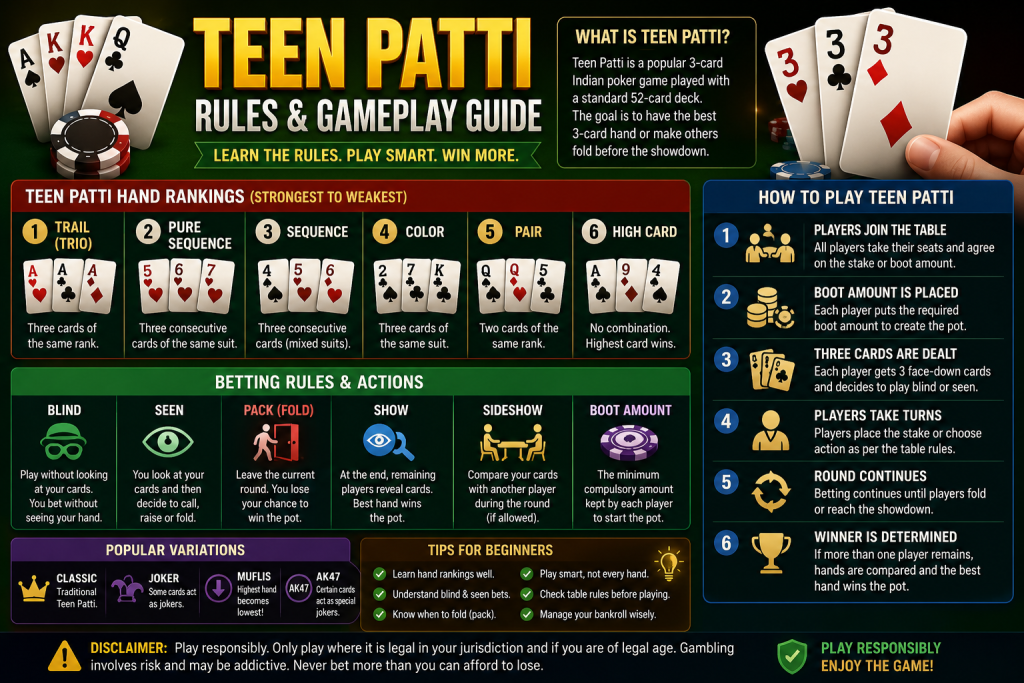
Hand rankings and player actions need separate explanations in an introduction to Teen Patti. Read examples of the categories alongside, but distinct from, blind, seen, pack and show. Compare both with the table’s own instructions rather than assume a general rule covers every variation.
Identify the detail you want before following a Teen Patti screen or file. A description of play, a release entry and an account instruction have different jobs. A sequence suited to your task makes a broad search easier to navigate.
Indian Android readers can use this article to connect the main subject with its existing product information. Details stay beside the task they explain instead of appearing as disconnected labels.
The focus is the game or format inside the app. General vocabulary, individual rules and the actions shown on a screen each need their own context.
Separate the meanings of a Teen Patti search result. A review concerns the product, an APK page its installation file and a login article an account already held. A game title, Android record and account-feature explanation may therefore require different reading.
Compare the title with the destination’s other details. Familiar designs and wording do not identify the publisher. Pause a download when records conflict and examine them before choosing a result.
Treat the lobby as an index of games. Open the format you want to learn and read its objective together with the sequence of turns. Similar illustrations cannot establish that two formats use the same rules.
Understand when the format ends a round and how its controls are labelled. Learn that vocabulary before changing formats; instructions from another game are not automatically applicable merely because both appear in the app.
Start with the overview, distinguish browsing from account access and individual games, then identify their labels. Open the area that answers the question rather than attempt every Teen Patti menu in one visit.
Record the screen where information appeared. A table-specific lobby message may have a narrower scope than an account notice. Keeping that distinction helps support enquiries and avoids turning one screen’s description into a rule for the whole app.
Two kinds of vocabulary appear in Teen Patti: hand categories and actions. Study rankings separately from blind, seen, pack, show and any other controls available in the chosen format. Learning one set does not explain the other.
Match a sample hand to the ranking table before considering the actions that might follow. Keep the particular table’s rules beside the example; a general introduction cannot fully describe every variation.
Select a specific comparison question first. It might concern game formats, interface clarity, Android releases or relevant help. Apply the same criteria to Teen Patti and each other entry.
Keep observations and assumptions distinct, noting whether information came from a listing or an app screen. A comparison should let another reader follow that evidence, rather than rank apps by their most prominent promotional headline.
Use the Teen Patti instructions relevant to the phone and task in front of you. Indian users may encounter different menus, English labels and connection conditions. Record the actual labels instead of assuming a screenshot will match exactly.
Read the explanation around an unfamiliar term before acting on it. A search snippet can make an application name, menu label and game format look similar. Identifying the subject avoids irrelevant troubleshooting.
Describe a support enquiry in order: the starting situation, what you did and what followed. Include the relevant phone and app versions and quote an error exactly instead of substituting a vague description.
Identify the guide or screen being followed at the time. That supplies context without requiring another person to reconstruct the visit. For an editorial correction, specify the passage and why it conflicts with the current app record.
Complete the relevant part of the app, device or game enquiry, then follow related reading for another topic. This Teen Patti article helps you choose a next question; it does not require every possible task to be completed at once.
Keep unanswered details in your notes rather than make assumptions. Request clarification where information is absent. One defined enquiry is a more useful basis for action than moving back and forth between unrelated pages.
In the standard Teen Patti format described here, each hand has three cards. Learn its category first, then the actions: rankings determine the comparison of qualifying hands at the end, while blind, seen, pack and show describe choices during play. Separating those two topics makes a round easier to follow.
Read the table’s ranking and tie-break rules before applying an example. General hand categories introduce the vocabulary, but a variation can need further explanation.
Blind and seen distinguish whether cards have been viewed. Pack leaves the current hand, while show is the hand-ending comparison under the applicable rules. Read sideshow separately, including its availability; an action’s name alone does not establish its conditions.
| Rank | Hand | Meaning |
|---|---|---|
| 1 | Trail / Trio | Three cards of the same rank |
| 2 | Pure Sequence | Three consecutive cards of the same suit |
| 3 | Sequence | Three consecutive cards of different or mixed suits |
| 4 | Color | Three cards of the same suit |
| 5 | Pair | Two cards of the same rank |
| 6 | High Card | No other combination |
A♠ A♥ A♦
7♠ 7♥ 7♣
5♥ 6♥ 7♥
4♠ 5♥ 6♦
2♣ 7♣ K♣
Q♠ Q♦ 5♣
A♣ 9♦ 4♠
Traditional Teen Patti may permit a sideshow request to another eligible player, subject to the particular table’s rules.
Knowing the rules is not an assurance of a win.
Responsible gaming: Where real-money Teen Patti is available, play only where legally permitted and if you meet the applicable age requirements. Gambling involves financial risk, and no strategy or hand guarantees a profit. Never wager more than you can afford to lose.
The deal gives each player three cards. During betting, players act blind or seen under the relevant rules and may continue, fold or take permitted actions such as sideshow. Hands still in play are compared at showdown.
A Trail, also called a Trio, tops the standard ranking: its three cards all have the same rank.
Where no pair, color, sequence, pure sequence or trail is present, the hand is a High Card, the lowest standard category.
Three consecutive cards sharing one suit form a pure sequence.
A color contains three cards of one suit without making a consecutive sequence.
Playing blind means deciding without first viewing the three cards.
A seen player views the cards before deciding what to do.
To pack is to fold and leave that round.
A sideshow compares eligible players’ hands during the round under the rules of the specific table.
Yes. Platforms and variations may alter betting mechanics, special cards, show and sideshow conditions, as well as other rules.
 App Review
Use this 66 Rummy overview to connect game formats, Android records and account questions…
 App Review
Investigate Gogo Rummy’s app record, Android installation and account access, with checks on bonus…
 App Review
Distinguish the All Yono Store directory, app and game records, then check Android details,…