Rummy Ludo: Game Guide: Understanding Formats and Rules
Learn Rummy Ludo by identifying the selected format, reading its turn structure and combinations,…


Last updated: 20 October 2026
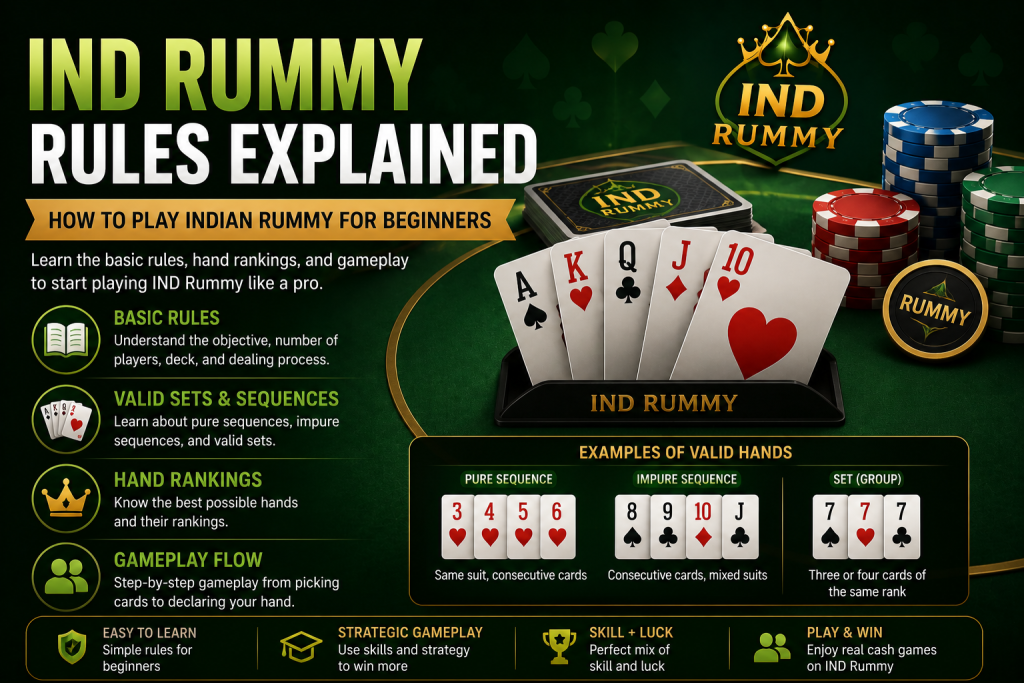
Learn how combinations relate to the order of a turn in IND Rummy. Sequences, sets and declarations belong together, so compare examples with the selected format’s instructions. An introduction establishes the terms; table rules give them their precise context for play.
A search for Indian Rummy may concern an overview, an Android package or account help. These are different tasks and should be distinguished before following detailed instructions.
Use the section that matches your situation while retaining the relevant application record. Existing information is grouped by purpose; related articles address a change in subject.
The focus is on understanding the game displayed inside the app. General terms, individual rules and actions on a screen each need to stay within their own context.
Are you comparing gameplay, locating an Android file or accessing an account again? Decide first so the relevant information receives attention and other sections can wait. An Indian Rummy enquiry does not always call for installation instructions.
Check the title alongside publisher, listing and release details. When screens appear to describe separate products, return to the intended record rather than merge their instructions.
Open the description of the selected game or table. An application name may cover several formats. Learn the objective, available actions and condition ending a round before interpreting every control.
Refer to the format’s own instructions and examine examples individually. Explain the aim of a turn and how the chosen move altered the position. Keep table-specific requirements distinct from general advice.
Find the lobby or home screen, the account area and the help section. This provides an interface map before you encounter unfamiliar labels.
Use game descriptions and the lobby to assess the selection, and account controls for existing-account access. Following one task at a time helps connect each result with the action that produced it.
Before comparing listings, prepare the same headings for each: identity, game description, Android details, navigation and the feature required. Consistent questions keep the comparison relevant.
Mark uncertain or absent details for checking instead of guessing. Work with what is available. If entries concern different products or formats, explain that first; similarly named apps may meet different needs.
Ask separately which card groups the format recognises and which moves are available now. This distinction clarifies how the hand connects to drawing, discarding and declaring.
Keep each example attached to its format. General card terminology provides an introduction, while the selected game’s instructions supply the specific rules. Resolve confusion about a combination before judging a move that relies on it.
For Indian Android readers, keep a note of the handset, installed release and task stage beside the instructions. This context is more useful than applying every step regardless of relevance.
Read an entire instruction before acting. Where labels differ, identify the task from its explanation rather than a button’s position. Record completed checks to make resuming or explaining the enquiry easier.
A request for help should describe the starting situation, action and resulting behaviour in order. Include relevant app and device releases and quote errors exactly.
Name the guide or screen followed when the issue occurred. This provides context without a reconstruction of the whole visit. For a proposed correction, identify the passage and its mismatch with the current app information.
Use the article to finish the question concerning your device, app or game, then pursue other topics through related reading. Every task need not be completed in one visit.
Keep unanswered points in your notes and seek clarification instead of assuming missing details. A focused question gives the next investigation a clearer starting point than switching repeatedly among unrelated pages.
View the hand as potential groups rather than isolated cards. Consecutive cards of one suit form a sequence; cards sharing a rank form a set under the relevant rules. A useful example shows both the grouping and why it is recognised.
In a pure sequence, no joker replaces a missing card. An impure sequence uses a substitute permitted by the format. Consult its explanation of printed and wild jokers, distinguishing those roles from a card’s ordinary rank.
Thirteen-card play is common, but the actual setup comes from the game and table details. Read their combination requirements, joker rules and scoring before using an example. Neatly arranged cards do not by themselves establish a valid declaration.
5♥ – 6♥ – 7♥
10♣ – J♣ – Q♣
3♠ – 4♠ – 5♠
7♦ – 8♦ – Joker
Under the applicable rules, substituting the joker for 9♦ can make this an impure sequence.
8♠ – 8♥ – 8♦
A joker can often replace a card in a combination that permits such substitution.
If 9♣ is designated the wild joker, for instance, the other nines may also serve that role under the particular rules.
4♥ – 5♥ – 6♥
8♣ – 8♦ – 8♠
Pure Sequence:
4♥ – 5♥ – 6♥
Second Sequence:
9♣ – 10♣ – J♣
Set:
7♠ – 7♥ – 7♦
Remaining valid combination:
2♠ – 2♥ – 2♦ – 2♣
6♠ – 7♠ – 8♠
Q♠ – Q♥ – Q♦
6♠ – 7♥ – 8♠
Q♠ – Q♥ – J♦
K♠
6♦ – 7♦
6♦ – 7♦ – 8♦
4♥ – 5♥ – 6♥ – 8♠ – 8♦ – 8♣ – 10♣ – J♣ – Q♣ – 3♦ – 4♦ – Joker – 9♠
8♠ – 8♦ – 8♣
Players should therefore avoid treating the game as a guaranteed way to make money.
If you’re playing a format involving money, understand the financial risks and applicable legal requirements before participating.
| Rule | What to Learn |
|---|---|
| Cards | How many cards are dealt |
| Sequence | How consecutive cards form combinations |
| Pure sequence | Sequence without a Joker substitute |
| Impure sequence | Sequence using a Joker |
| Set | Same rank, different suits |
| Joker | How Jokers work |
| Draw | How to select a card |
| Discard | How to remove a card |
| Declaration | When and how to declare |
| Scoring | How unmatched cards are valued |
| Winning | Conditions required to win |
Practical app guidance is also relevant before play. Use the IND Rummy APK download guide for pre-download checks, then the how to install IND Rummy APK article for Android setup. The IND Rummy latest version guide explains verification and updating. For package security, privacy, account protection and related considerations, read the IND Rummy safety guide.
If a game involves money or other stakes, users should understand the financial risks and independently check the laws and regulations applicable to their location before participating.
Do not treat gaming as a guaranteed source of income.
Generally, turns involve drawing and discarding while building accepted sets and sequences. The precise IND Rummy requirements depend on the format.
After receiving a hand, organise possible groups. Draw and discard on your turns until the required valid sequences and sets are formed, then declare.
Consecutive cards of one suit make a pure sequence when no joker substitutes for a card.
Usually, a set groups equal ranks from different suits.
A joker normally replaces another card only in eligible groups, as permitted by the specific rules.
One common format deals 13 cards per player, but the actual format may differ.
In standard play, winning requires the prescribed valid groups and a correct declaration under that game’s rules.
A declaration that fails the requirements may incur a format-specific penalty. Consult the current IND Rummy rules for its scoring.
Free-play availability depends on the platform’s present selection. Review the current formats and terms before taking part.
 App Review
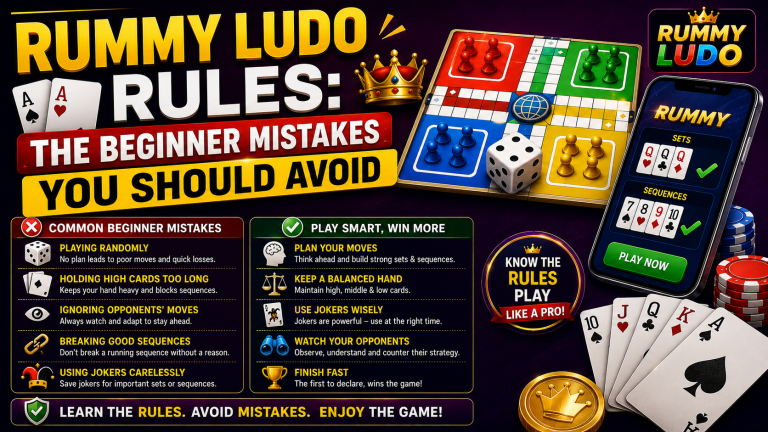
Learn Rummy Ludo by identifying the selected format, reading its turn structure and combinations,…
 App Review
Read the individual Max Rummy format in context: its objective, turn actions and ending…
 App Review
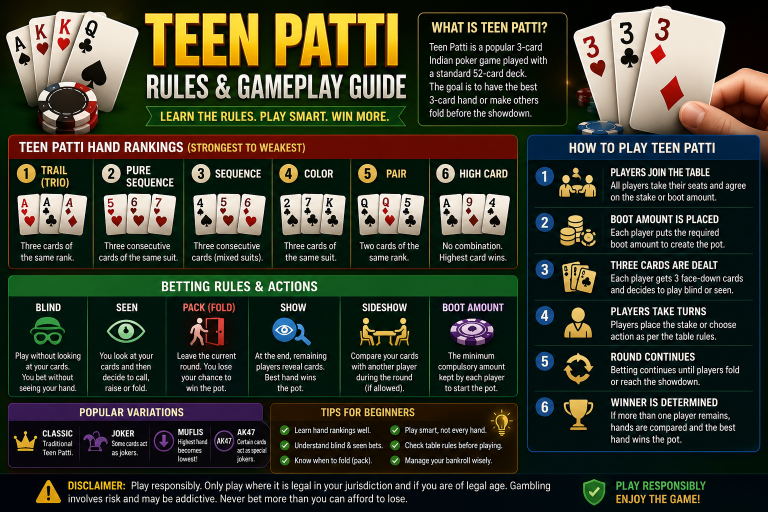
Understand standard Teen Patti hands and actions separately, then check the current table’s rules…