66 Rummy on Android: Games and Getting Started
Use this 66 Rummy overview to connect game formats, Android records and account questions…


Last updated: 20 October 2026
Has Rummy Ludo launched, or does the trouble occur before you reach its account screen? Establish that distinction first: restoring account access calls for different instructions from fixing an Android installation.
Check which product a search result describes before using it. Rummy Ludo results may concern a particular release, a feature or another similarly named application. The accompanying record should match what you intended to find.
Work through the information relevant to your immediate task, after confirming the subject. Write down anything the explanation leaves unanswered. Statements about payments, eligibility or security belong to their stated feature and context.
This article concerns signing back into an account you already have. Reinstalling the app, registering another account and recovering an existing one serve separate purposes; none should be treated as an interchangeable login step.
What brought you to the guide: comparing gameplay, finding an Android installer or returning to your account? Decide before proceeding. An answer tailored to that question will be more useful than another set of download instructions, and unrelated sections can wait.
Compare the app name with its publisher, listing and version information. Conflicting screens may refer to separate products. In that case, find the matching record again instead of assembling instructions from both.
Identify the account you intend to access and choose the corresponding form. Normal sign-in uses known credentials; recovery addresses lost access; registration starts a new account. A failed attempt alone is not a reason to switch between all three.
Observe where access stops after launch. Copy any on-screen message and note what happens after one retry. These details connect the advice to the account stage actually reached, rather than a vague report that the app does not work.
A stalled download, an Android installation error, a crash at launch and a message on the login screen describe four different failures. Classify yours before adjusting the phone or application.
Test changes separately and record each outcome. Changing networks while completing a download or switching releases obscures which action mattered. When requesting assistance, give the shortest clear reproduction of the issue and the relevant app and handset versions.
Follow the menus displayed on your own phone. Across India, handset layouts, English labels and network conditions vary, so a screenshot may differ from your screen. Your notes should use the wording you actually encounter and the Rummy Ludo record relevant to your task.
Pause at an unfamiliar term and read its explanation. In a brief result, a game format can resemble a menu entry or product name. Clarifying which it is can spare you a sequence of irrelevant checks.
Once inside Rummy Ludo, look through the lobby or home page, then locate the account section and help instructions. Knowing where these areas sit makes unfamiliar interface labels easier to place.
Keep each check within its topic. Browse the lobby and game descriptions when evaluating the selection; follow the account route when restoring access. Jumping between them makes it difficult to connect a visible result to the action that caused it.
For a support enquiry, describe what was happening before the problem, what you did and what happened next. Add the relevant device and app versions. Quote errors precisely so that the reader has more than a general description to investigate.
Name the page or app screen whose instructions you followed. That context is more useful than asking someone to retrace your browsing. To report a correction, identify the disputed passage and explain how it conflicts with the current application information.
Use this page to resolve the account question in front of you, rather than trying every possible task in one session. After finishing the part relevant to your device, application or game, consult another article for a separate issue.
Leave gaps in your notes as questions rather than guesses. Seek clarification where a needed detail is absent. A focused enquiry gives the next check a clearer direction than cycling through unrelated pages.
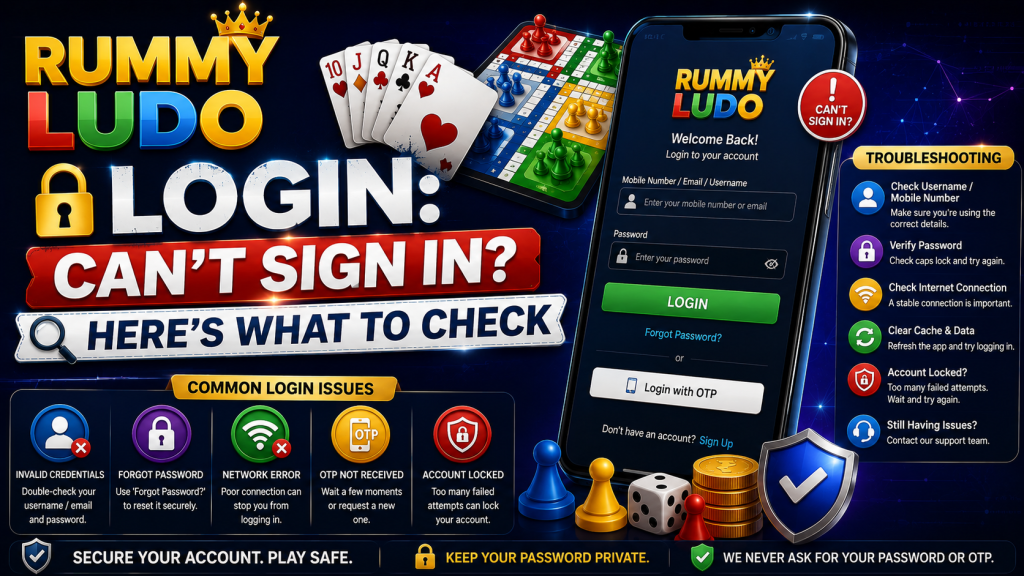
When you cannot check a balance, view activity or resume a session, a Rummy Ludo login failure can be frustrating. It does not by itself establish that the account is unavailable. Mistyped credentials, an unreliable connection, an older app or a temporary service fault are possible explanations.
Investigate in stages. Repeated password guesses or a fresh registration can make the situation harder to untangle.
Confirm the identifier attached to this account: it might be a username, phone number, email or another identifier. Even with the right password, a typing error in that field can prevent access.
After changing account details or a password, enter the updated information. A previously saved value may no longer work.
First distinguish a password you cannot remember from an account identifier that is wrong.
Where password recovery is available, follow the service’s official route instead of continuing to guess.
Be especially careful with third-party pages claiming to recover your account. Never give your password or verification code to someone who says they can “unlock” the account for you.
Some login systems use one-time passwords or verification codes.
Most importantly, never share an OTP with another person.
However, be careful with APK files obtained from unknown websites. Installing a modified or unverified package can introduce a completely different security problem while you are trying to solve a login issue.
Consider whether this password is used elsewhere and whether you recently typed your credentials into a website you did not recognise.
Never provide your password, OTP, recovery code, or other authentication credentials to another person.
The same warning applies if someone asks for your password, OTP, payment details, or remote access to your device.
Another device may have a different saved password, browser session, app installation or mobile number available. Check those differences when comparing the results.
Confirm all four fields that apply: username, phone number, email address and password.
Never include your password or OTP in a support request.
Troubleshooting a Rummy Ludo login can be straightforward. Possible causes include a forgotten password, incorrect account information, weak connectivity, an outdated app and a temporary restriction on the account.
Begin by checking the connection and credentials. Use recovery or OTP verification if required, then examine app and account status before larger changes. Keep private sign-in information protected throughout.
The main Rummy Ludo resource covers the broader platform. For a transaction question or an eligible balance you intend to cash out, continue with the Rummy Ludo Withdrawal guide.
Work through the possibilities individually: wrong credentials, password difficulties, a connection fault, delayed OTPs, app trouble, temporary account restrictions or a service problem. Repeated sign-in attempts do not identify which one applies.
Use the official password-recovery option provided by the service. Avoid giving your password or recovery information to another person claiming to be able to restore your account.
Confirm the account uses the phone number or email you are checking, and test the connection. Allow time between code requests instead of sending several rapidly.
Do not assume that this is allowed. Account policies can vary, and creating another account could cause additional verification or account-management issues. Try recovering the original account first.
Allow the account to finish loading, then inspect the account details or transaction record available. Use the withdrawal help information if the missing information concerns a withdrawal specifically.
You should not share your OTP or password with another person. Complete verification through the service's normal account interface or documented support process.
Use the service's official security or account-recovery process and secure your credentials. Avoid communicating private authentication information to unknown individuals.
 App Review
Use this 66 Rummy overview to connect game formats, Android records and account questions…
 App Review
Investigate Gogo Rummy’s app record, Android installation and account access, with checks on bonus…
 App Review
Distinguish the All Yono Store directory, app and game records, then check Android details,…